Best Outdoor Lighting for Hurricane-Prone Areas
Outdoor lighting in hurricane-prone areas must handle far more than heavy rain. High winds, salt air, humidity, flooding, intense heat, and electrical disturbances can damage fixtures, wiring, connections, and controls.
Florida properties face many of these conditions throughout the year, making fixture construction and installation quality especially important.
Aloha Outdoor Lighting designs and installs outdoor lighting systems for properties with local weather exposure, drainage, and long-term reliability in mind.
What Makes Hurricane-Prone Areas Hard on Outdoor Lighting?
High wind gets most of the attention during hurricanes, but water and corrosion often create longer-term lighting problems. Wind-driven rain can reach fixture seams, mounting points, cable entries, and connections that remain relatively protected during ordinary rainfall. Saturated soil can also leave ground fixtures and underground connections surrounded by water.
Coastal air adds another concern. Salt deposited on exposed metal accelerates corrosion around screws, brackets, fixture threads, connectors, and damaged finishes. A fixture body can still look acceptable while smaller mounting components begin deteriorating.
Florida heat and ultraviolet exposure also age plastic components, cable jackets, seals, gaskets, and finishes. Hurricane-resistant lighting should consequently be treated as a complete system rather than judged by the fixture housing alone.
Start With Fixtures Rated for Wet Locations
A fixture described as "outdoor" is not automatically suitable for every exterior location. One of the most important distinctions is whether equipment is rated for damp or wet locations.
Damp-location fixtures are generally intended for areas exposed to moisture or condensation but protected from direct water contact. Wet-location fixtures are designed for environments where water can reach the equipment directly. Exposed walls, garden beds, uncovered patios, walkways, docks, pool areas, and open landscape installations commonly require greater protection.
Wind-driven hurricane rain makes the distinction particularly important. Rain during a major storm can travel sideways and reach parts of a fixture that would rarely get wet during normal weather.
Look for recognized wet-location certifications and manufacturer specifications rather than relying on terms like "weather resistant" or "outdoor friendly." Those descriptions alone reveal little about how the fixture was tested.
Pay Attention to IP Ratings, but Understand Their Limits
IP ratings provide useful information about a fixture enclosure's resistance to solids and water. The first digit addresses solid-object and dust protection, while the second addresses water ingress.
IP65 is a useful benchmark for many exposed outdoor lighting applications because it indicates dust protection and resistance to water jets. Locations facing greater exposure may justify IP66 equipment or products engineered specifically for severe conditions.
A high IP rating does not automatically make a fixture hurricane-resistant. The rating does not tell you whether mounting hardware will remain secure in high winds, whether the finish can tolerate years of salt exposure, or whether underground electrical connections have been installed correctly.
Ground-recessed fixtures also require separate attention. Equipment that handles heavy rain from above may not be designed for temporary submersion after saturated soil or poor drainage causes water to collect around it.
Fixture Material Matters Near the Coast
Material selection becomes increasingly important closer to the coast. Low-quality cast-metal fixtures with thin coatings can begin corroding around fasteners, seams, scratches, and threaded components. Once a protective finish has been compromised, deterioration can spread beneath the coating.
Marine-grade or high-quality stainless steel can work well for certain applications when the complete fixture and its hardware are suited to coastal exposure. Brass is another strong option for landscape lighting because it develops a natural patina instead of depending entirely on a thin surface coating.
Quality copper fixtures offer similar benefits where their appearance and cost fit the project.
Powder-coated aluminum can perform well when properly manufactured and maintained. Scratches and chips deserve attention because they expose the underlying material and create potential starting points for deterioration.
Small hardware components matter just as much as the main fixture body. A premium fixture secured with poor-quality screws, brackets, stakes, or anchors still has a weak point. Corrosion resistance should extend to the complete mounting assembly.
Low-Voltage Landscape Lighting Has Important Advantages
Quality low-voltage lighting is particularly useful for residential landscapes. Common 12-volt systems can illuminate pathways, trees, architectural features, gardens, entrances, and outdoor living areas without carrying standard line voltage to every landscape fixture.
Low voltage does not make careless installation acceptable. Transformers, conductors, connectors, splices, and fixture connections still need to be selected for outdoor conditions. Cable should be appropriate for wet environments, sunlight exposure, and its intended installation method.
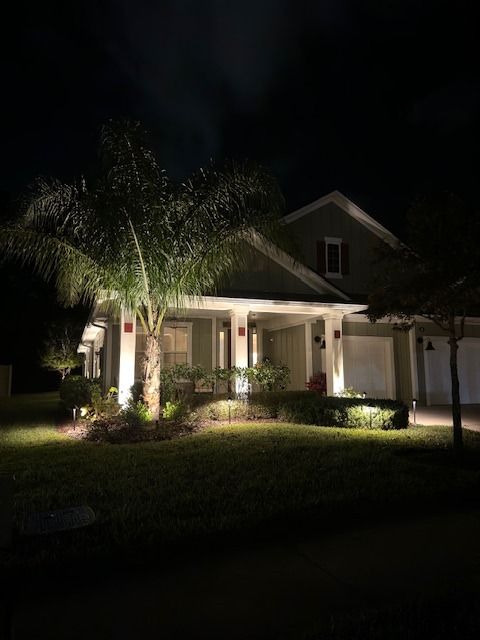
Cable routing deserves attention in hurricane-prone yards. Areas that routinely flood, receive downspout discharge, or collect irrigation water are poor choices for vulnerable connections. Landscaping work, roots, edging, and drainage changes can also affect buried cable over time.
Longer lighting runs require proper voltage planning. Cable size, fixture wattage, transformer capacity, and run length influence performance. Correct system design helps prevent distant fixtures from becoming dim or unstable.
Mounting Strength Can Matter as Much as Fixture Strength
A durable fixture attached to a weak mounting point remains vulnerable during severe weather. Wall lights, floodlights, tree-mounted fixtures, post lights, and landscape lights need mounting methods suited to the surface and level of exposure.
Large decorative fixtures deserve special attention because their size provides more surface area for wind pressure. Tall path lights and bollards can also experience substantial leverage at their bases. Loose stakes, deteriorated masonry anchors, aging wooden posts, and weak mounting blocks may become failure points.
Landscape fixtures should remain secure through routine mowing, irrigation, foot traffic, soil movement, and yard maintenance. A fixture that has gradually loosened over several months is less prepared for tropical-storm or hurricane-force winds.
Tree-mounted lighting requires careful installation as well. Tree growth and movement need to be considered so fixtures and wiring do not become damaged or overly constrained over time.
Ground Lights Need Extra Protection From Water
Well lights and recessed ground fixtures face conditions that wall-mounted equipment may never encounter. Heavy tropical rainfall can saturate soil quickly, leaving a fixture surrounded by water even when the location normally drains well.
Ground-recessed fixtures should be specifically designed for that installation method. A standard wet-location fixture is not automatically suitable for installation where temporary standing water or saturated soil is possible.
Drainage around each ground fixture should be evaluated before installation. Low areas, downspout discharge zones, roof runoff, poorly draining soil, and planting beds that routinely hold water increase the likelihood of moisture problems.
Fixture placement can sometimes solve the problem more effectively than upgrading the fixture itself. Moving a light several feet away from a drainage problem may provide greater long-term reliability than installing expensive equipment in a location that repeatedly floods.
Choose LED Lighting With Quality Electronics
LED lighting is well suited to hurricane-prone landscapes because it provides useful illumination with low power consumption and long operating life. Yet LED quality can vary substantially between products that appear nearly identical.
Drivers, circuit boards, seals, thermal management, and internal connections influence how well a fixture performs over time. Heat management deserves special attention in Florida because high ambient temperatures add stress to electronic components. Poorly designed fixtures can trap additional heat around the LED and driver.
Serviceability should also influence product selection. Some professional landscape fixtures allow lamps or internal components to be replaced instead of requiring replacement of the entire fixture. Integrated LED fixtures can provide excellent sealing when properly engineered, but future replacement cost should still be considered.
Color temperature matters for residential applications as well. Warm white
LEDs around 2700K to 3000K usually complement landscaping and architecture without creating an overly cool or harsh appearance.
Surge Protection Deserves Serious Attention
Hurricane-related electrical damage does not require a direct lightning strike. Voltage disturbances can reach lighting equipment through utility service, nearby lightning activity, switching events, and other connected electrical equipment.
LED drivers, transformers, smart controllers, photocells, timers, and electronic relays can be vulnerable to voltage spikes. Surge protection should be considered during system planning rather than added only after equipment begins failing.
Good electrical protection also depends on proper grounding, bonding, wiring, and listed equipment. No surge protection device can guarantee survival during a direct lightning strike, so products promising complete lightning protection should be viewed cautiously.
Transformer and control placement also matters. Equipment should not be mounted where stormwater regularly collects, roof runoff pours over it, or irrigation repeatedly sprays the enclosure. Manufacturer requirements for mounting orientation, clearance, ventilation, and weather exposure should always be followed.
Lighting Placement Should Support Safety After a Storm
Storm-ready lighting should illuminate the areas people are most likely to use. Entrances, stairs, elevation changes, walkways, gates, driveways, pool boundaries, and access points deserve priority.
Several properly positioned fixtures usually provide more useful visibility than one extremely bright floodlight. Excessive brightness can create glare, particularly during heavy rain when wet pavement, walls, leaves, and water droplets reflect light toward the viewer.
Shielded path lights can define walking routes without producing distracting glare. Downlighting can illuminate larger areas naturally when suitable mounting locations are available. Carefully aimed accent lights can contribute useful ambient illumination without shining directly into windows or neighboring properties.
Brightness should match the task. More lumens do not automatically mean safer outdoor spaces. Good placement, beam control, fixture height, and aiming usually have a greater effect on nighttime visibility.
Inspect Outdoor Lighting Before Hurricane Season
Preventive maintenance can reveal small problems before severe weather makes them worse. Fixtures should be checked for movement, cracked lenses, damaged seals, exposed conductors, deteriorated cable, corrosion, and loose hardware.
Landscape lighting deserves another inspection after major yard work. Mowers, trimmers, edging, planting, and mulch installation can disturb cables or knock fixtures out of alignment. Growing plants can also block light output or hold moisture around fixtures.
Coastal properties may need periodic removal of salt deposits according to fixture manufacturer recommendations. Harsh chemicals and abrasive cleaning methods should be avoided when they could damage protective coatings.
A post-storm inspection is equally valuable. A system that still turns on may have shifted fixtures, loosened mounting hardware, damaged wiring, water intrusion, or partially compromised electronic components that are not immediately noticeable.
What Should You Look for When Buying Hurricane-Area Outdoor Lighting?
No single specification makes an outdoor light "hurricane-proof." Fixture selection requires several characteristics to work together.
Start with the environmental rating and confirm that the fixture is suitable for its exact installation location. Check water protection, construction material, exposed hardware, mounting design, cable requirements, driver quality, and manufacturer installation instructions. Properties near saltwater should place extra emphasis on corrosion resistance.
Serviceability also deserves consideration. Outdoor lighting can remain installed for many years, making replacement lamps, drivers, lenses, stakes, connectors, and other components valuable over the life of the system.
Price alone is a poor measure of storm durability. Costly decorative fixtures can still be inappropriate for severe exposure, and inexpensive products may save money through thinner coatings, basic seals, weaker mounting hardware, or lower-grade electronics.
The strongest hurricane-area lighting systems combine wet-location-rated fixtures, appropriate water protection, corrosion-resistant materials, secure mounting, quality LEDs, protected connections, sensible drainage, and properly installed electrical equipment. Selecting each component for the conditions it will actually face gives outdoor lighting a much better chance of performing reliably through Florida's demanding weather.